
Sights
Bahnstadt Heidelberg
Rising heating, rent and running costs have forced many people to rethink how they live. Bahnstadt is two steps ahead: since the first residents moved in in 2012, this district has been known for its innovative construction. But what is the green district of Bahnstadt actually about - and is it really as green as it claims?
- District
- Bahnstadt
- Getting there
- Open route
The history of Heidelberg’s Bahnstadt
Converting the freight yard
The area was not always vacant land or a building site. It was abandoned territory belonging to Deutsche Bahn - disused freight yards and shunting grounds behind the main station, land that was finally to find a use again after years of dereliction.
”Campus II”
One thing is certain: without science, Bahnstadt would never have existed. The passive-house development stands out not only for its forward-looking design but also because part of the area was dedicated to research institutes.
Thanks to the “Campus” area, Bahnstadt offers space not only for housing but also for business and research. Developing the site opened up dozens of opportunities, both to live and to carry out research.
Why was Bahnstadt built?
One hotly debated issue in local politics at the time was housing. Heidelberg was short of space, so living space was needed - or more precisely, land to build on. To get to grips with the housing shortage, the city decided to create Heidelberg’s 15th district and build on the former freight yard. Faced with rising energy and rental costs, and following the city’s climate protection goals, the decision was taken to make Bahnstadt as energy-efficient as possible.
The largest passive-house development in the world
Construction of sustainable housing has risen sharply in Germany in recent years, but nothing surpasses this project: Bahnstadt is the largest passive-house development in the world.
Building technology
Welcome to paradise for environmental engineers. Bahnstadt scores highly on its technology. Ventilation systems with heat recovery keep the warmth inside the buildings.
Photovoltaic arrays cover many rooftops, making the most of the sun on hot, cloudless days.
New energy-saving concepts are standard here, for example adjustable LED street lights. You will be surprised what lies behind those white façades.
What is a passive house?
A passive house is an energy-efficient building that needs very little heating energy thanks to excellent insulation and ventilation with heat recovery. Such houses are often combined with other sustainable energy sources such as heat pumps and photovoltaic systems.
Passive houses in Bahnstadt
The passive-house approach has dozens of advantages. Passive houses need only a fraction of the heating energy of conventional buildings. Smart-home controllers help residents track their energy consumption and identify weak points.
Green concepts
Bahnstadt is convincing not only in its research: the very design of the district was an environmental achievement.
The district’s heat is supplied as district heating from a wood-fired combined heat and power plant. Combined with the energy efficiency of the buildings, this keeps CO2 emissions to a minimum. Further ideas such as collecting rainwater for the garden or small planted terraces are left to residents themselves.
Sustainability
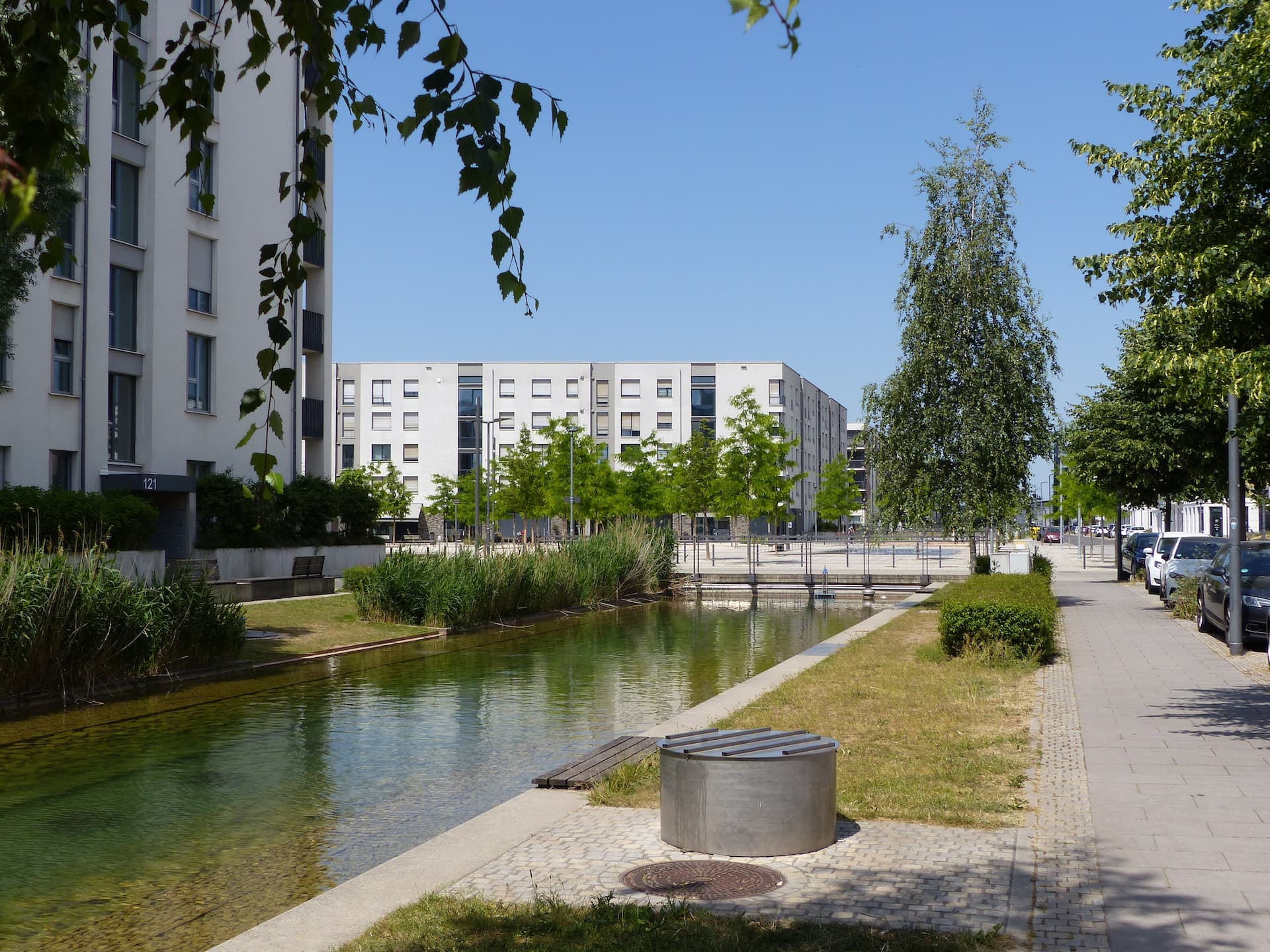
Because sustainability should be a visible act rather than just a word, around 14 hectares of the new district are planned as green and open space. The animals benefit too: protected lizard species were taken into account during construction.
Transport connections
The transport links fit the forward-looking concept. At the centre of the district there is a low-traffic zone to reduce noise for residents, though driving through is not a problem. The neighbouring B37 provides easy access from further afield.
Public transport is a particular strength: Heidelberg’s main station connects the new with the old, linking Bahnstadt to the Old Town, so that even from the far edge of Heidelberg you have an easy connection to all the historic sights. Tram lines 22 and 26 at Gadamerplatz run to the south exit of the main station. Neighbouring stops such as Czernybrücke and Eppelheimer Terrasse (within Bahnstadt) are within walking distance.
What the district offers
Playgrounds of every kind dot the green spaces of Bahnstadt. Children and families will be amazed at the range on offer.
Bahnstadt has certainly scored on family friendliness. Places such as the Langer Anger, with its long water feature that is ideal for children to play in and cool off on hot days, show how open and welcoming the district really is. The district also has its own primary school.
There is plenty for the appetite too, with a variety of cafés and restaurants. Events such as district festivals give residents a memorable time in the sun - and above all among people. Residents now insist on these small traditions.
Conclusion
Bahnstadt is an important centre of the future, of family life and of culture. The former open land was used to create much-needed housing close to the main station, and today flats sit between trees and terrace after terrace.
Shortly after completion, dozens of events for information, social life and culture sprang up in the district. Bahnstadt is a milestone in urban development and will remain a model for all future passive-house developments for decades to come.
Tours & Tickets
Tours & Tickets nearby
Guided tours and entry tickets around Bahnstadt Heidelberg - book directly.
* Tours & tickets by GetYourGuide. If you book through the markers, we earn a commission at no extra cost to you.